
Common Mistakes
10 Common English Mistakes to Avoid in Everyday Conversations
Published on September 17, 2026
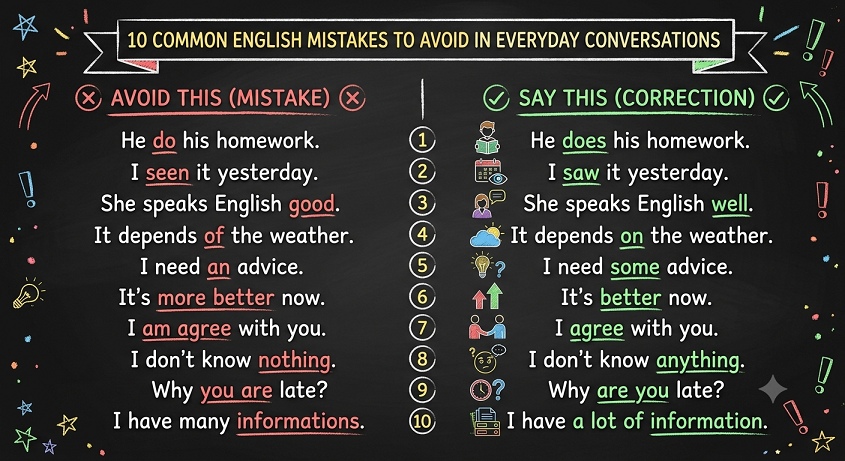
Small English mistakes can make your sentences sound unnatural. Learn 10 common mistakes people make in everyday conversations and discover the simple, natural alternatives.
Speaking English confidently is not only about knowing a lot of words. It is also about using common words and sentence patterns correctly.
Many English learners make small mistakes while speaking because they translate sentences directly from their native language or use grammar patterns that sound correct but are not natural in English.
Here are 10 common mistakes and the natural ways to say them.
1. “He don't know.”
❌ He don't know the answer.
✅ He doesn't know the answer.
With **he, she, and it**, use **doesn't**, not **don't**.
**More examples:**
* She doesn't like coffee.
* He doesn't work here.
* It doesn't look difficult.
2. “I didn't went there.”
❌ I didn't went to the market.
✅ I didn't go to the market.
After **didn't**, always use the base form of the verb.
**More examples:**
* I didn't see him.
* She didn't call me.
* We didn't buy anything.
Not:
❌ I didn't saw him.
Instead:
✅ I didn't see him.
3. “I am having a doubt.”
This expression is common among English learners, but it doesn't sound natural in everyday English.
Instead, say:
✅ I have a question.
For example:
❌ I am having a doubt about this lesson.
✅ I have a question about this lesson.
You can also say:
**“I'm not sure about this.”**
4. “I am going to home.”
❌ I am going to home.
✅ I am going home.
We normally don't use **to** before “home” when talking about going or coming.
**Examples:**
* I'm going home.
* She went home early.
* What time are you coming home?
But with a specific place, use **to**:
* I'm going to the office.
* She's going to the market.
* We're going to school.
5. “Discuss about the problem.”
❌ We need to discuss about the problem.
✅ We need to discuss the problem.
The verb **discuss** does not normally need “about” after it.
**Examples:**
* Let's discuss the plan.
* We discussed the problem yesterday.
* We need to discuss this matter.
However, you can say:
**“Let's talk about the problem.”**
6. “I have many works to do.”
❌ I have many works to do today.
✅ I have a lot of work to do today.
When “work” means tasks or activities in general, it is usually an **uncountable noun**.
So we say:
* I have a lot of work.
* I have too much work today.
* I still have some work to finish.
For individual tasks, you can say:
**“I have several tasks to complete.”**
7. “She is my cousin sister.”
❌ She is my cousin sister.
✅ She is my cousin.
In standard English, **cousin** already tells us that the person is a relative. You don't need to add “brother” or “sister.”
You can say:
* She's my cousin.
* He's my cousin.
If you specifically want to mention gender, you can say:
**“She's my female cousin.”**
But in everyday conversation, **“She's my cousin”** is the natural choice.
8. “Return back.”
❌ Please return back the book tomorrow.
✅ Please return the book tomorrow.
The word **return** already means “go or give something back,” so “back” is usually unnecessary.
You can say:
* Please return the book tomorrow.
* I returned the keys to him.
* She returned home late.
You can also say:
**“Give the book back to me.”**
9. “I am waiting for you since morning.”
❌ I am waiting for you since morning.
✅ I have been waiting for you since morning.
When an action started in the past and is still continuing, **present perfect continuous** is often the natural choice.
**Examples:**
* I've been waiting for you for an hour.
* She's been working here since January.
* We've been talking about this for weeks.
Remember:
**since** = starting point
**for** = period of time
For example:
* since Monday
* since morning
* since 2024
* for two hours
* for three days
* for several years
10. “I am understanding.”
❌ I am understanding what you mean.
✅ I understand what you mean.
Some verbs are not normally used in the continuous form when they describe a state rather than an action.
For example:
❌ I am knowing the answer.
✅ I know the answer.
❌ I am understanding.
✅ I understand.
❌ I am liking this song.
✅ I like this song.
These small changes can make your English sound much more natural.
A Simple Way to Avoid These Mistakes
Don't try to memorize hundreds of grammar rules at once. Instead, pay attention to the sentences you use every day.
When you notice a mistake, write down:
**Incorrect:** I didn't went there.
**Correct:** I didn't go there.
Then use the correct sentence several times in different situations.
For example:
* I didn't go to the office.
* I didn't go shopping.
* I didn't go out yesterday.
* I didn't go because I was tired.
This helps you remember the pattern naturally.
Final Thoughts
Making mistakes is a normal part of learning English. The important thing is to notice your mistakes and gradually replace incorrect patterns with natural ones.
You don't need complicated vocabulary to communicate well. Focus on using **simple, accurate, and natural sentences** in your everyday conversations.
The more you listen, speak, and practice, the more naturally these patterns will become part of your English.
Many English learners make small mistakes while speaking because they translate sentences directly from their native language or use grammar patterns that sound correct but are not natural in English.
Here are 10 common mistakes and the natural ways to say them.
1. “He don't know.”
❌ He don't know the answer.
✅ He doesn't know the answer.
With **he, she, and it**, use **doesn't**, not **don't**.
**More examples:**
* She doesn't like coffee.
* He doesn't work here.
* It doesn't look difficult.
2. “I didn't went there.”
❌ I didn't went to the market.
✅ I didn't go to the market.
After **didn't**, always use the base form of the verb.
**More examples:**
* I didn't see him.
* She didn't call me.
* We didn't buy anything.
Not:
❌ I didn't saw him.
Instead:
✅ I didn't see him.
3. “I am having a doubt.”
This expression is common among English learners, but it doesn't sound natural in everyday English.
Instead, say:
✅ I have a question.
For example:
❌ I am having a doubt about this lesson.
✅ I have a question about this lesson.
You can also say:
**“I'm not sure about this.”**
4. “I am going to home.”
❌ I am going to home.
✅ I am going home.
We normally don't use **to** before “home” when talking about going or coming.
**Examples:**
* I'm going home.
* She went home early.
* What time are you coming home?
But with a specific place, use **to**:
* I'm going to the office.
* She's going to the market.
* We're going to school.
5. “Discuss about the problem.”
❌ We need to discuss about the problem.
✅ We need to discuss the problem.
The verb **discuss** does not normally need “about” after it.
**Examples:**
* Let's discuss the plan.
* We discussed the problem yesterday.
* We need to discuss this matter.
However, you can say:
**“Let's talk about the problem.”**
6. “I have many works to do.”
❌ I have many works to do today.
✅ I have a lot of work to do today.
When “work” means tasks or activities in general, it is usually an **uncountable noun**.
So we say:
* I have a lot of work.
* I have too much work today.
* I still have some work to finish.
For individual tasks, you can say:
**“I have several tasks to complete.”**
7. “She is my cousin sister.”
❌ She is my cousin sister.
✅ She is my cousin.
In standard English, **cousin** already tells us that the person is a relative. You don't need to add “brother” or “sister.”
You can say:
* She's my cousin.
* He's my cousin.
If you specifically want to mention gender, you can say:
**“She's my female cousin.”**
But in everyday conversation, **“She's my cousin”** is the natural choice.
8. “Return back.”
❌ Please return back the book tomorrow.
✅ Please return the book tomorrow.
The word **return** already means “go or give something back,” so “back” is usually unnecessary.
You can say:
* Please return the book tomorrow.
* I returned the keys to him.
* She returned home late.
You can also say:
**“Give the book back to me.”**
9. “I am waiting for you since morning.”
❌ I am waiting for you since morning.
✅ I have been waiting for you since morning.
When an action started in the past and is still continuing, **present perfect continuous** is often the natural choice.
**Examples:**
* I've been waiting for you for an hour.
* She's been working here since January.
* We've been talking about this for weeks.
Remember:
**since** = starting point
**for** = period of time
For example:
* since Monday
* since morning
* since 2024
* for two hours
* for three days
* for several years
10. “I am understanding.”
❌ I am understanding what you mean.
✅ I understand what you mean.
Some verbs are not normally used in the continuous form when they describe a state rather than an action.
For example:
❌ I am knowing the answer.
✅ I know the answer.
❌ I am understanding.
✅ I understand.
❌ I am liking this song.
✅ I like this song.
These small changes can make your English sound much more natural.
A Simple Way to Avoid These Mistakes
Don't try to memorize hundreds of grammar rules at once. Instead, pay attention to the sentences you use every day.
When you notice a mistake, write down:
**Incorrect:** I didn't went there.
**Correct:** I didn't go there.
Then use the correct sentence several times in different situations.
For example:
* I didn't go to the office.
* I didn't go shopping.
* I didn't go out yesterday.
* I didn't go because I was tired.
This helps you remember the pattern naturally.
Final Thoughts
Making mistakes is a normal part of learning English. The important thing is to notice your mistakes and gradually replace incorrect patterns with natural ones.
You don't need complicated vocabulary to communicate well. Focus on using **simple, accurate, and natural sentences** in your everyday conversations.
The more you listen, speak, and practice, the more naturally these patterns will become part of your English.