
Common Mistakes
10 Common English Mistakes You Should Stop Making
Published on September 07, 2026
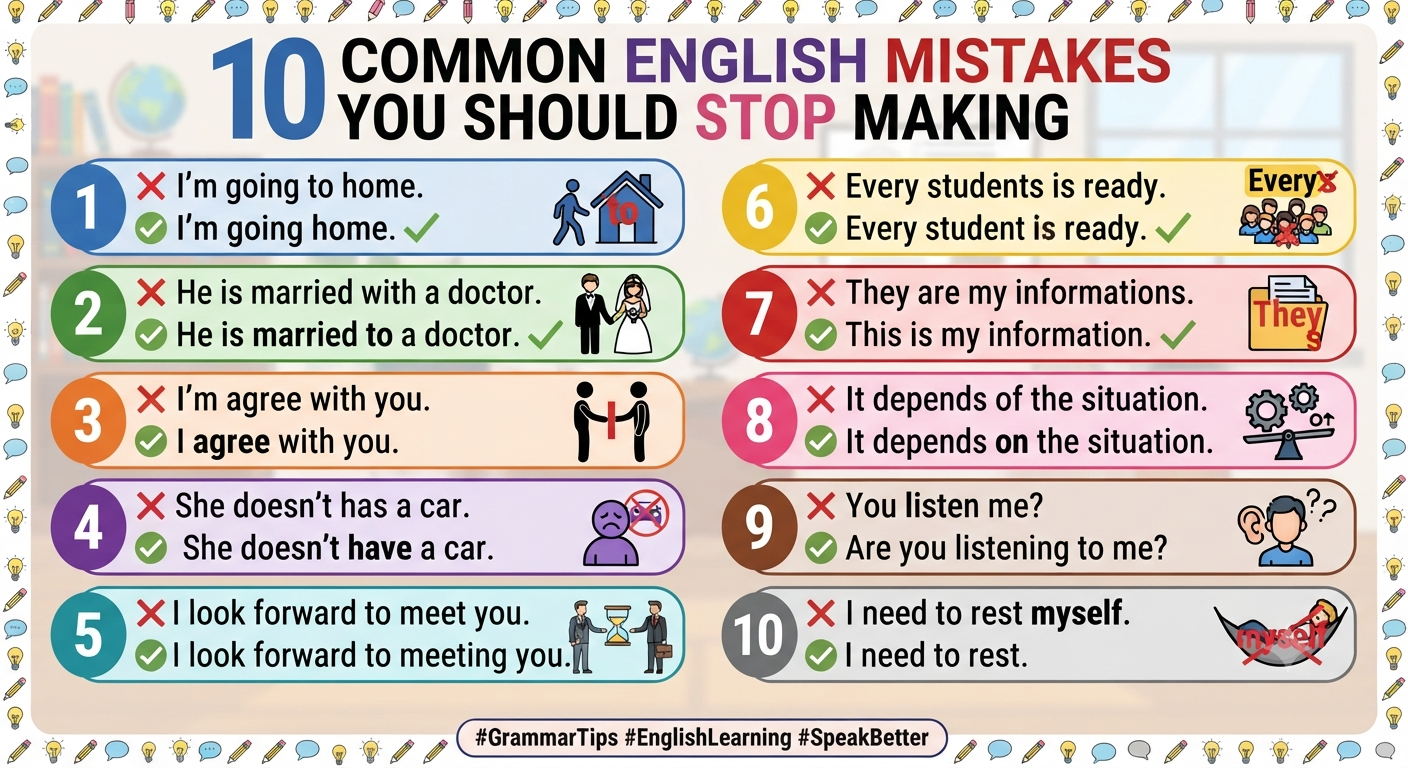
Learn 10 common English mistakes that many learners make and discover simple, natural ways to correct them.
Many English learners know a lot of vocabulary and grammar rules but still make small mistakes when speaking or writing. The good news is that most common mistakes are easy to correct once you become aware of them.
Here are 10 common English mistakes you should stop making.
1. I am having a car.
Incorrect: **I am having a car.**
Correct: **I have a car.**
Use **have** to talk about possession. We normally don't use the continuous form “am having” for possession.
2. He don't like coffee.
Incorrect: **He don't like coffee.**
Correct: **He doesn't like coffee.**
With **he, she, and it**, use **doesn't**, not “don't.”
3. I didn't went there.
Incorrect: **I didn't went there.**
Correct: **I didn't go there.**
After **didn't**, always use the base form of the verb.
4. She is married with a doctor.
Incorrect: **She is married with a doctor.**
Correct: **She is married to a doctor.**
The correct preposition is **to**, not “with,” when talking about someone's spouse.
5. I am living here since 2020.
Incorrect: **I am living here since 2020.**
Correct: **I have been living here since 2020.**
When an action started in the past and is still continuing, we commonly use the **present perfect continuous** with “since” or “for.”
6. I have a good news for you.
Incorrect: **I have a good news for you.**
Correct: **I have good news for you.**
**News** is an uncountable noun, so we don't say “a news” or “a good news.”
7. She gave me an advice.
Incorrect: **She gave me an advice.**
Correct: **She gave me some advice.**
**Advice** is uncountable. Say **some advice** or **a piece of advice**, not “an advice.”
8. I am agree with you.
Incorrect: **I am agree with you.**
Correct: **I agree with you.**
**Agree** is a verb, so we don't use “am” before it.
9. He is good in English.
Incorrect: **He is good in English.**
Correct: **He is good at English.**
Use **good at** when talking about someone's ability or skill.
For example: **She is good at mathematics.**
10. I discussed about the problem with him.
Incorrect: **I discussed about the problem with him.**
Correct: **I discussed the problem with him.**
The verb **discuss** doesn't need “about” after it.
Learning from these small mistakes can make your English sound much more natural. Don't be afraid of making mistakes. Notice them, correct them, and try using the correct forms in your next conversation.
Here are 10 common English mistakes you should stop making.
1. I am having a car.
Incorrect: **I am having a car.**
Correct: **I have a car.**
Use **have** to talk about possession. We normally don't use the continuous form “am having” for possession.
2. He don't like coffee.
Incorrect: **He don't like coffee.**
Correct: **He doesn't like coffee.**
With **he, she, and it**, use **doesn't**, not “don't.”
3. I didn't went there.
Incorrect: **I didn't went there.**
Correct: **I didn't go there.**
After **didn't**, always use the base form of the verb.
4. She is married with a doctor.
Incorrect: **She is married with a doctor.**
Correct: **She is married to a doctor.**
The correct preposition is **to**, not “with,” when talking about someone's spouse.
5. I am living here since 2020.
Incorrect: **I am living here since 2020.**
Correct: **I have been living here since 2020.**
When an action started in the past and is still continuing, we commonly use the **present perfect continuous** with “since” or “for.”
6. I have a good news for you.
Incorrect: **I have a good news for you.**
Correct: **I have good news for you.**
**News** is an uncountable noun, so we don't say “a news” or “a good news.”
7. She gave me an advice.
Incorrect: **She gave me an advice.**
Correct: **She gave me some advice.**
**Advice** is uncountable. Say **some advice** or **a piece of advice**, not “an advice.”
8. I am agree with you.
Incorrect: **I am agree with you.**
Correct: **I agree with you.**
**Agree** is a verb, so we don't use “am” before it.
9. He is good in English.
Incorrect: **He is good in English.**
Correct: **He is good at English.**
Use **good at** when talking about someone's ability or skill.
For example: **She is good at mathematics.**
10. I discussed about the problem with him.
Incorrect: **I discussed about the problem with him.**
Correct: **I discussed the problem with him.**
The verb **discuss** doesn't need “about” after it.
Learning from these small mistakes can make your English sound much more natural. Don't be afraid of making mistakes. Notice them, correct them, and try using the correct forms in your next conversation.