
Grammar
Present Perfect vs Past Simple: What Is the Difference?
Published on September 07, 2026
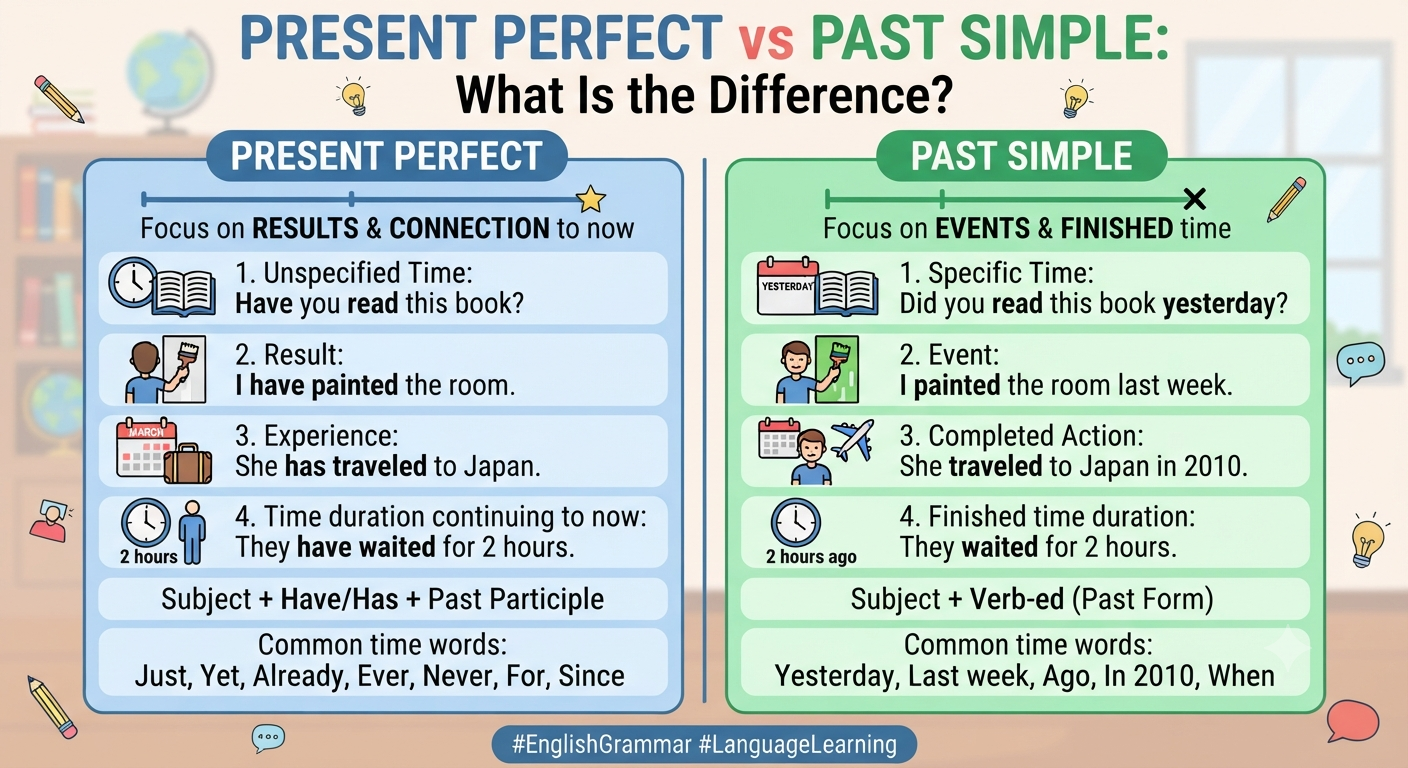
Learn the difference between the present perfect and past simple with clear explanations and practical examples.
The present perfect and past simple are two tenses that often confuse English learners. Both can describe past events, but we use them in different situations.
The past simple is generally used when we talk about something that happened at a specific, finished time in the past.
For example:
“I visited Delhi last year.”
“She called me yesterday.”
“We watched a movie on Saturday.”
Words such as “yesterday,” “last year,” “last week,” and “in 2022” often appear with the past simple.
The present perfect connects the past with the present. We often use it when the exact time isn't important or when something has a present connection.
For example:
“I have visited Delhi several times.”
“She has called me twice today.”
“We have watched that movie before.”
Compare these two sentences:
“I went to London in 2023.”
“I have been to London several times.”
The first sentence refers to a specific finished time. The second talks about life experience without specifying when.
Another important difference is with unfinished periods.
“I had three cups of coffee yesterday.”
“I have had three cups of coffee today.”
Yesterday is finished, so we use the past simple. Today is still in progress, so the present perfect can be used.
Understanding this difference will help you speak more accurately and naturally. Instead of memorizing complicated rules, pay attention to whether the time is finished and whether the action has a connection with the present.
The past simple is generally used when we talk about something that happened at a specific, finished time in the past.
For example:
“I visited Delhi last year.”
“She called me yesterday.”
“We watched a movie on Saturday.”
Words such as “yesterday,” “last year,” “last week,” and “in 2022” often appear with the past simple.
The present perfect connects the past with the present. We often use it when the exact time isn't important or when something has a present connection.
For example:
“I have visited Delhi several times.”
“She has called me twice today.”
“We have watched that movie before.”
Compare these two sentences:
“I went to London in 2023.”
“I have been to London several times.”
The first sentence refers to a specific finished time. The second talks about life experience without specifying when.
Another important difference is with unfinished periods.
“I had three cups of coffee yesterday.”
“I have had three cups of coffee today.”
Yesterday is finished, so we use the past simple. Today is still in progress, so the present perfect can be used.
Understanding this difference will help you speak more accurately and naturally. Instead of memorizing complicated rules, pay attention to whether the time is finished and whether the action has a connection with the present.