
Grammar
Since vs For: Learn the Difference with Simple Examples
Published on September 07, 2026
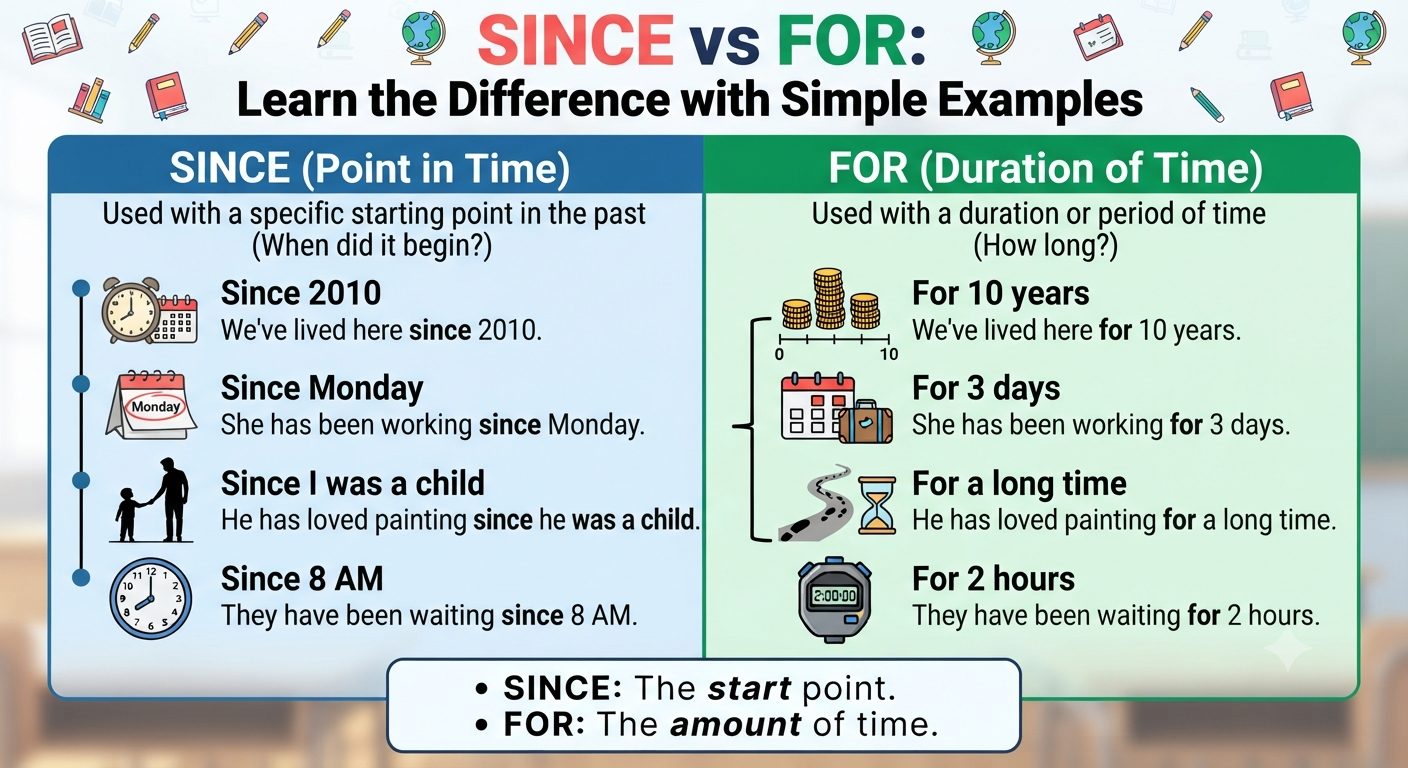
Confused about “since” and “for”? Learn when to use each one with simple explanations and everyday examples.
“Since” and “for” are both commonly used when talking about time, but they have different meanings.
Use since when you mention the starting point of an action.
For example:
“I've lived here since 2018.”
“She has worked there since January.”
“We've known each other since school.”
The starting points are 2018, January, and school.
Use for when you mention the length or duration of an action.
For example:
“I've lived here for eight years.”
“She has worked there for six months.”
“We've known each other for a long time.”
The expressions “eight years,” “six months,” and “a long time” describe duration.
A simple way to remember the difference is:
Since = starting point
For = duration
Compare:
“I've been waiting since 9 o'clock.”
“I've been waiting for two hours.”
Both sentences describe the same ongoing situation, but the first gives the starting time while the second gives the duration.
Avoid saying:
“I've been here since two hours.”
Instead, say:
“I've been here for two hours.”
And don't say:
“I've been here for Monday.”
Say:
“I've been here since Monday.”
Once you understand whether you're talking about a starting point or a period of time, choosing between “since” and “for” becomes much easier.
Use since when you mention the starting point of an action.
For example:
“I've lived here since 2018.”
“She has worked there since January.”
“We've known each other since school.”
The starting points are 2018, January, and school.
Use for when you mention the length or duration of an action.
For example:
“I've lived here for eight years.”
“She has worked there for six months.”
“We've known each other for a long time.”
The expressions “eight years,” “six months,” and “a long time” describe duration.
A simple way to remember the difference is:
Since = starting point
For = duration
Compare:
“I've been waiting since 9 o'clock.”
“I've been waiting for two hours.”
Both sentences describe the same ongoing situation, but the first gives the starting time while the second gives the duration.
Avoid saying:
“I've been here since two hours.”
Instead, say:
“I've been here for two hours.”
And don't say:
“I've been here for Monday.”
Say:
“I've been here since Monday.”
Once you understand whether you're talking about a starting point or a period of time, choosing between “since” and “for” becomes much easier.